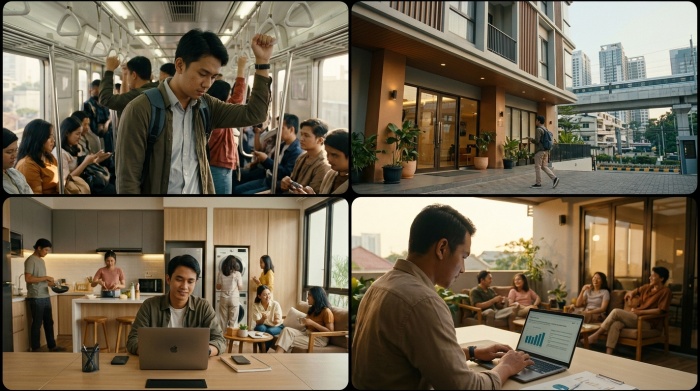
Coliving—private bedrooms combined with shared facilities—could meet the needs of young professionals who want to live near work or public transportation without managing every household detail themselves. The opportunity is supported by high levels of commuting across Greater Jakarta. Statistics Indonesia (BPS) recorded around 4.4 million commuters in 2023, with 81.9% engaged primarily in work. More recent BPS data recorded approximately 3.23 million commuters in the Jabodetabekpunjur metropolitan area in 2025. The figures may use different definitions and geographic coverage, so they should not be compared directly.
From a business perspective, the model is worth testing if the location, rental rates, and occupancy levels support healthy margins. Its viability is not guaranteed: renovation costs, building rent, competition from boarding houses and apartments, and operating expenses can reduce profitability. A practical approach is to start with one property and test demand before expanding.
1. Business Concept
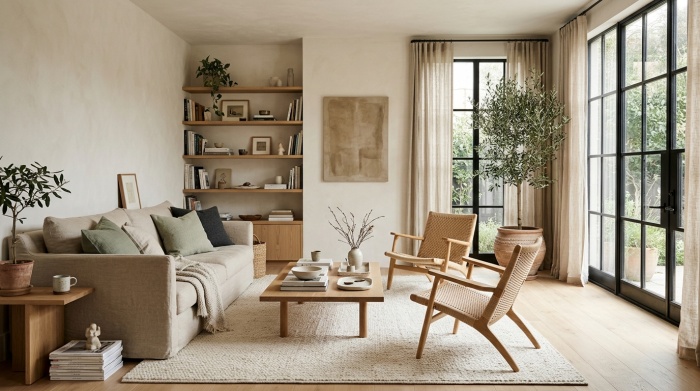
Modern coliving combines private bedrooms with shared spaces and services. The core offering could include:
- Furnished rooms with private bathrooms, air conditioning, and internet access.
- A kitchen, lounge, work area, and laundry facilities.
- A package price that includes selected bills and services.
- Maintenance, cleaning of shared areas, and digital booking.
- Optional community activities, such as shared meals or skills workshops.
The key differentiator is more than interior design. It is the convenience of moving in, predictable costs, a location that makes commuting easier, and responsive property management.
2. Target Market and Location
The primary target market is professionals aged approximately 22–35 who are starting their careers, moving from another city, working on a contract or flexible schedule, or not yet ready to rent an entire home. They may work in business districts, hospitals, universities, service centers, or industrial areas.
Locations should be assessed based on residents’ needs, rather than reputation alone. Potential areas include neighborhoods near the MRT, KRL commuter rail, LRT, TransJakarta, office districts, and employment centers across Jakarta, Tangerang, Bekasi, Depok, and Bogor. Key factors to compare include:
- Commute time to workplaces and access to public transportation.
- The price and availability of comparable boarding houses, apartments, and coliving spaces.
- Safety, street lighting, food options, and access to daily necessities.
- Building rent or property acquisition costs.
- Flood risk, limited parking, noise, and neighborhood conditions.
BPS commuter data points to significant cross-regional travel in Greater Jakarta, but the number of commuters alone does not prove demand for coliving at a specific site. Demand must still be validated in the area surrounding the chosen property.
3. Revenue Model
The main revenue source is monthly room rent. Additional income could come from parking, laundry, workspace rental, or in-room cleaning packages. Additional charges should be transparent so residents are not misled by the advertised price.
Two common operating models are:
- Property ownership: Requires significant capital, but the owner controls the asset and does not pay rent to another property owner.
- Property leasing and management: Requires less upfront capital than buying a property, but involves fixed rent and occupancy risk.
For a new business, leasing and managing a property can be a way to test the market, provided the lease allows coliving use and the financial projections remain viable at conservative occupancy levels.
4. Financial Feasibility Simulation
The following is a simple illustration for a 40-room property. These figures are planning assumptions, not market prices or guaranteed projections. Actual rents, costs, taxes, and property conditions should be validated through local research and quotes.
Monthly assumptions
| Item | Assumption |
|---|---|
| Number of rooms | 40 |
| Average rent per room | IDR 3,200,000 |
| Average occupancy | 90% |
| Rental revenue | IDR 115,200,000 |
| Additional revenue | IDR 4,000,000 |
| Total revenue | IDR 119,200,000 |
| Building rent | IDR 35,000,000 |
| Operations and utilities | IDR 20,000,000 |
| Marketing | IDR 4,000,000 |
| Maintenance and replacement items | IDR 5,000,000 |
| Administration and services | IDR 3,000,000 |
| Total operating costs | IDR 67,000,000 |
| Indicative operating surplus | IDR 52,200,000 |
With an indicative initial investment of IDR 1.2 billion for renovation, furniture, access systems, deposits, and setup costs, the simple payback period would be approximately 23 months. This calculation excludes loan interest, taxes, depreciation, property purchase costs, periods without income during renovation, and unexpected expenses. It should not be treated as a guaranteed return.
Sensitivity Analysis
At the same room rate, occupancy directly affects revenue. If occupancy falls from 90% to 75%, rental revenue falls from IDR 115.2 million to IDR 96 million per month. If rent and other fixed costs remain unchanged, the operating surplus could shrink considerably.
Before signing a lease, the business owner should test at least three scenarios—conservative, base, and optimistic—accounting for promotional periods, vacant rooms, late payments, and cost increases. The business is more resilient if it can still cover recurring costs under a realistic conservative scenario.
5. Investment and Operations
The initial budget typically covers room and shared-area renovations, furniture, appliances, internet infrastructure, security systems, deposits, marketing, and contingency funds. The total will depend heavily on the building’s condition and the service standard.
Operations should have clear procedures for:
- Resident screening and rental agreements.
- Complaints, repairs, and emergencies.
- Cleaning and maintenance of shared facilities.
- Rules for kitchens, workspaces, parking, and guests.
- Billing, deposits, overdue payments, and move-out procedures.
- Resident privacy and access security.
The operator should also confirm that business permits and building use comply with local regulations. Zoning status, the property owner’s consent, tax obligations, building safety, and local environmental requirements should be reviewed before renovation and operations begin.
6. Key Risks and Mitigation
Occupancy below target. Test interest through a simple booking page, local advertising, prospective-resident interviews, and a waiting list before renovating every room.
Fixed costs that are too high. Negotiate the preparation period, rent increases, lease duration, repair responsibilities, and the right to install facilities.
Price competition. Compare similar rooms and differentiate through cleanliness, reliable internet, an easy move-in process, responsive management, and a well-chosen location.
Conflicts among residents. Set clear house rules, provide a channel for complaints, and ensure a manager can respond quickly.
Property damage and unexpected expenses. Set aside maintenance funds and inspect the building and facilities regularly.
Permit and lease risks. Verify permits, building-use rules, and contract terms with someone familiar with local regulations.
7. Feasibility Testing Steps
- Select two or three micro-locations and map their access to transportation and employment centers.
- Survey at least 15–20 boarding houses, apartments, and comparable properties to record prices, amenities, and availability.
- Interview prospective residents about their budgets, commute times, preferred facilities, and rental periods.
- Obtain renovation and operating cost estimates, then prepare projections for three scenarios.
- Check the building’s condition, local rules, permits, and the property owner’s consent.
- Test the marketing and gather prospective tenants before opening all units.
- Run one property as a pilot project, then review occupancy, cost per room, length of stay, and complaints over several months.
Conclusion
A coliving business for young professionals in Greater Jakarta has a reasonable market basis, supported by high workforce mobility and cross-regional commuting. However, the business is financially viable only if the chosen location attracts residents, rental prices match their ability to pay, and occupancy is high enough to cover fixed costs.
Investment decisions should be based on research at the neighborhood level and cash-flow projections that include a low-occupancy scenario. Starting with one pilot property allows the operator to test pricing, amenities, and management practices before expanding.
Our Service Locations
Bandung and West Java: Bandung, Cimahi, Sumedang, Tasikmalaya, Garut, Subang, Cianjur, Sukabumi, Ciamis, Bogor, Cirebon, Karawang, and Cikampek.
Jakarta and Surrounding Areas: Jakarta, Tangerang, Banten, Bogor, Depok, and Bekasi.
Across Indonesia: Java, Bali, Timor, Sumatra, Kalimantan, Sulawesi, Maluku, Papua, Lombok, and Flores.
With extensive experience in handling diverse projects in Jakarta and Bandung, we possess a deep understanding of the urban character and natural environment of each city, allowing us to respond with a design approach that is both contextual and sophisticated.
www.rytamautama.com